Article
Source & provenance
Author (RSS): Vamsi Krishna Sankarayogi · Category: AI · Published label: Sat, 14 Feb 2026 08:59:01 GMT
Cached on this site: Mar 31, 2026 at 5:40 PM · See methodology for how content is fetched and summarized.
There is a peculiar moment in every technologist’s life when the cloud – once romantic, elastic, and infinite – begins to feel slightly excessive. You provision a Kubernetes cluster to automate a browser. You spin up GPUs to summarize PDFs. You deploy Terraform to manage the thing that manages the thing. And then someone quietly pushes a small, fanless box across the desk and says, “Why not just run it here?” That box, more often than not, is a Mac Mini. And the software it ends up running, increasingly, looks suspiciously like OpenClaw.
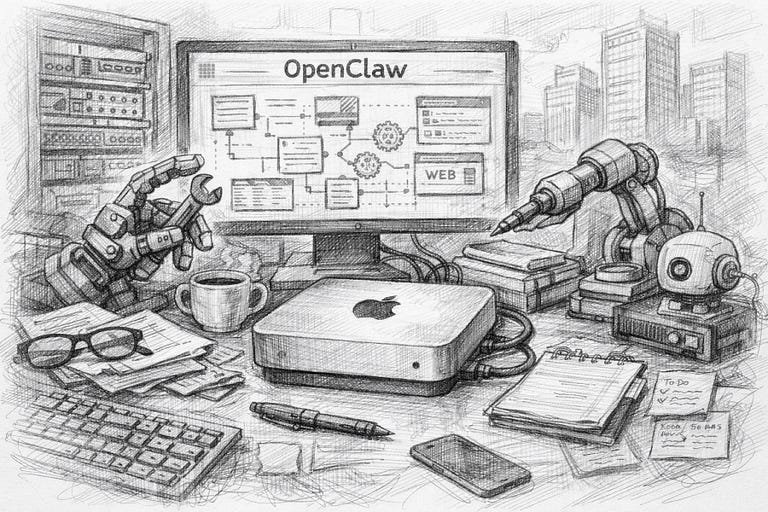
OpenClaw sits in the emerging class of agentic automation frameworks: local-first, model-agnostic, tool-augmented systems that behave less like scripts and more like mildly obsessive interns. It can reason over context, call external tools, manipulate files, browse the web, execute shell commands, and orchestrate workflows in a way that blurs the line between RPA, LLM orchestration, and controlled chaos. If traditional automation was “if X then Y,” OpenClaw is “given this messy objective, derive a plan, refine it, call tools, verify outputs, and iterate.” In other words, it is deterministic ambition layered over probabilistic cognition.
The architectural model is deceptively simple: an LLM-driven planner wrapped in a tool execution substrate, often communicating via structured interfaces (JSON schemas, OpenAPI specs, or MCP-style contracts). The planner decomposes intent into actions; the executor binds those actions to tools; the environment maintains state. In practice, this means OpenClaw can be pointed at a directory of contracts and asked to extract indemnity clauses, generate risk summaries, update a spreadsheet, and send a Slack message – without requiring the user to explain what a for-loop is. The agent performs reasoning traces internally, invokes tools explicitly, and attempts a convergence loop until the task satisfies its objective function (or until you revoke its shell access, whichever comes first).
Where things become interesting – borderline theatrical – is in its deployment topology. While the cloud remains the natural habitat of distributed compute, OpenClaw thrives surprisingly well on the Mac Mini. The reasons are less sentimental than they appear.
First, silicon. Modern Mac Minis built on Apple Silicon provide high-performance CPU cores, efficient GPU acceleration, and unified memory architecture. Unified memory is not a marketing term here; it materially reduces memory-copy overhead between CPU and GPU contexts, which benefits local model inference and embedding pipelines. For running quantized LLMs, embedding models, vector databases, and lightweight orchestration layers, this architecture is not merely adequate – it is elegant.
Second, thermodynamics. The Mac Mini is engineered for sustained workloads in a compact thermal envelope. Agent frameworks are bursty: planning, inference, embedding, indexing, tool invocation. They do not resemble crypto mining or video rendering; they resemble a caffeinated analyst with unpredictable peaks of thought. The Mini handles this pattern gracefully, without sounding like a drone preparing for takeoff.
Third, economics. A Mac Mini is a one-time capital expense. Running an agent stack 24/7 in the cloud incurs ongoing operational expenditure – compute hours, storage IOPS, egress fees, monitoring overhead. When OpenClaw is used for internal automation – document processing, local devops scripting, compliance evidence gathering – the cost model of a fixed local node is compelling. You can run a vector store, a small orchestration server, and a local model without explaining to finance why your “AI curiosity” line item now resembles a mid-sized SaaS subscription.
Fourth, sovereignty. Many OpenClaw use cases involve sensitive data: source code, internal logs, contracts, financial models. Running the orchestration locally mitigates exposure risks. Data never needs to leave the device unless explicitly configured. For teams concerned about prompt leakage, model logging, or cross-tenant contamination in hosted services, the Mac Mini becomes a quiet fortress – an on-prem agent node disguised as a lifestyle accessory.
The use cases span from the mundane to the faintly subversive.
In software engineering, OpenClaw can traverse repositories, map dependency graphs, generate architecture summaries, refactor modules, and draft migration plans. Unlike static analysis tools, it operates semantically: it understands intent, not just syntax. Developers use it to create release notes from commit histories, reconcile environment variables across Docker files, or validate configuration drift. On a Mac Mini in the corner of a dev lab, it becomes an always-on code auditor.
In compliance and SOC 2 readiness, it can monitor log directories, parse CloudWatch exports, correlate alarms, and generate evidence artifacts. Rather than manually screenshotting dashboards at quarter-end, teams instruct the agent to compile structured compliance packets. The Mini quietly assembles PDFs while the humans attend meetings about “culture.”
In research and content analysis, OpenClaw ingests whitepapers, annotates them, builds embeddings, clusters themes, and drafts technical summaries. It can cross-reference multiple PDFs, detect contradictions, and propose synthesis paragraphs. On a local node, it becomes a private research assistant – less likely to hallucinate under supervision, and less likely to leak your half-written grant proposal.
In operations, it acts as an orchestrator: restarting services, validating environment health, tailing logs, and escalating anomalies. It is not merely a chatbot; it is a policy-bound executor. If configured with guardrails, it can be restricted to predefined tool interfaces, preventing arbitrary shell access. If misconfigured, it can attempt to reorganize your home directory in pursuit of “efficiency.” This duality is why serious teams treat it less like a toy and more like an infrastructure component.
There is also a peculiar creative use case: local generative experimentation. Designers and engineers use OpenClaw to batch-process assets, generate metadata, rename files intelligently, and prepare datasets. When paired with local image or text models, the Mac Mini becomes a generative workshop – no rate limits, no queue times, no API throttling emails politely reminding you that creativity is billable.
One might ask: why not a rack server? Why not a Linux box? The answer is partly cultural. The Mac Mini is ubiquitous in developer ecosystems. It integrates cleanly with Unix tooling, runs containerized stacks, supports virtualization, and does so with minimal friction. It can sit under a monitor in an office, drawing little attention while acting as a persistent agent host. There is something subversively satisfying about enterprise automation being powered by a device that could also edit family photos.
OpenClaw’s trajectory mirrors a broader architectural shift: from centralized monolithic AI services to distributed agent nodes. Instead of sending every task to a remote API, teams deploy lightweight local orchestrators that selectively call external models when necessary. The Mac Mini becomes an edge compute node in an agent mesh – performing preprocessing, enforcing policies, and only escalating to larger models when complexity exceeds local capacity.
Of course, the humor lies in the contrast. We spent a decade migrating everything to the cloud, only to rediscover the charm of a small box on a desk. We containerized, virtualized, and orchestrated our way into hyperscale abstraction – then installed an AI agent on a Mac Mini and called it innovation. Yet this oscillation is not regression; it is optimization. Compute is being placed where it makes the most architectural sense.
OpenClaw, in that sense, is less about automation and more about topology. It forces teams to confront questions of locality, trust boundaries, tool governance, and cost efficiency. The Mac Mini is not a nostalgic choice; it is a rational node in a distributed AI system.
And so, in offices and labs, quiet aluminum squares hum gently while agents plan, reason, and execute. The cloud still exists, vast and elastic. But sometimes the future of automation is not in a distant region – it is under your monitor, thinking.