Article
Source & provenance
Canonical URL: https://medium.com/@vsankarayogi/keralas-100-literacy-claim-a-statistic-that-became-a-myth-7b4286fe543b?source=rss-9ef69f64a6c------2
Author (RSS): Vamsi Krishna Sankarayogi · Category: AI · Published label: Wed, 21 Jan 2026 18:23:50 GMT
Cached on this site: Mar 31, 2026 at 5:40 PM · See methodology for how content is fetched and summarized.
Kerala is a Southern State of India. Its Geographically beautiful state with Rich language and Serene beaches.
Kerala is often described as India’s “100% literate” state, a claim repeated with pride by politicians, echoed by sympathetic commentators, and widely accepted as an unquestionable fact. Over time, this phrase has taken on a life of its own. It is no longer treated as a statistical milestone but as a moral badge — evidence of cultural and ideological superiority. Yet the moment we pause to ask what “100% literacy” actually means, the certainty begins to dissolve.
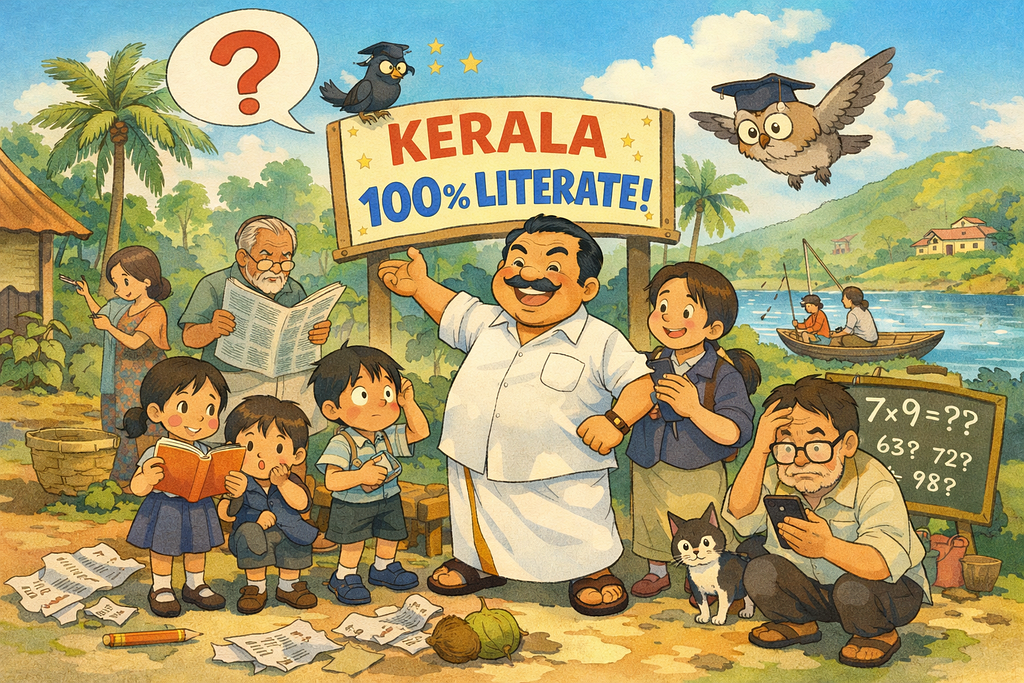
In official terms, literacy in India has a very modest definition. A person is considered literate if they can read and write a simple sentence in any language with understanding. That is the benchmark on which Kerala’s achievement rests. By this standard, the state’s success is genuine and significant. Decades of social reform, missionary education, public schooling, and adult literacy campaigns created near-universal access to basic reading and writing. This is not a trivial accomplishment, especially in a country with deep historical inequalities.
The problem begins when this narrow definition is silently expanded into something much larger. Literacy is increasingly assumed to mean comprehension, reasoning, critical thinking, and intellectual independence. In reality, the ability to read a sentence does not automatically translate into the ability to understand complex ideas, evaluate arguments, detect misinformation, or apply knowledge in real-world situations. Literacy, as measured, guarantees access to text — not mastery of thought.
This distinction matters because Kerala, like the rest of India, continues to struggle with shallow public discourse, emotional reasoning, ideological rigidity, and widespread susceptibility to propaganda. These are not signs of a deeply literate society in the broader sense. If 100% literacy truly implied widespread critical thinking and scientific temper, such vulnerabilities would be exceptions rather than norms.
Over time, the literacy statistic has shifted from being a measure of progress to an identity marker. It is often invoked defensively, especially when questions are raised about education quality, employability, research output, or skill relevance. The assertion of “100% literacy” becomes a conversational full stop, a way to dismiss critique rather than engage with it. In that moment, a useful metric turns into a myth.
Modern literacy is no longer a single skill. It is layered and complex. It includes comprehension, numeracy, digital discernment, civic understanding, and the ability to learn continuously. By these standards, no society on earth is fully literate — not Scandinavian countries, not East Asian education powerhouses, and certainly not Kerala. Treating a minimal threshold as a final destination breeds complacency.
This complacency has real consequences. Kerala faces persistent graduate unemployment, a mismatch between education and market skills, limited innovation ecosystems, and the steady migration of its most capable minds. These challenges cannot be explained away by past achievements. They demand honest assessment, not nostalgic pride.
The real question, therefore, is not whether Kerala achieved 100% literacy by an old definition, but whether it is willing to confront the limits of that definition today. How well do people understand what they read? Can they think independently in the face of ideological pressure? Are schools and universities producing curious problem-solvers or merely credentialed individuals?
Kerala’s true success lies in having built a strong educational foundation. That foundation deserves respect. But foundations exist to support growth, not to be endlessly admired. When a statistic becomes sacred, it stops being useful. Progress begins when societies are willing to revise their self-image and raise their standards.
It is time to move beyond the comfort of the “100% literacy” claim and aim for something more demanding and more honest — not just a literate society, but a genuinely thinking one.